
By Chris Paparone.
In the October 2014 issue of The Journal of Military History, Robert W. Hutchinson published his illuminating article subtitled, “Wehrmacht Officers, the U.S. Army Historical Division, and U.S. Military Doctrine, 1945–1956.” Hutchinson tells the story about how, “…over 700 former field and staff officers of the German Armed Forces…closely collaborated with the U.S. Army Historical Division to complete some 2,500 manuscripts describing the Wehrmacht’s experiences in World War II.” These compilations centered on the concepts of Combined Arms Maneuver (konzept der verbundenen Waffen) and Decisive Action (entschlossenes Handeln) — I make the acronym “CAMDA” — developed by German military intellectuals during the interwar period and practiced on both fronts of the war in Europe. These have been and are believed to be the hallmark concepts of modern warfare. What makes these concepts remarkable is that they have served as the foundation for Army operational doctrine from post-WW II (FM 100-5) publications to the latest, 2016 edition (ADRP 3-0).
My concern is whether this nearly century-old operational concept focused on prosecuting modern mechanized warfare is a winning way to fight the conflicts we have experienced since WW II; after all, the Germans lost, yet the United States adopted Wehrmacht CAMDA concepts and has struggled with winning wars through Korea, Vietnam, Afghanistan, Iraq, and Syria. Some might argue that Operation Desert Storm (1991) was a war decisively won with a variant of CAMDA (then called AirLand Battle), but I interpret that action as the beginning of a continuous conflict that is still unresolved in Iraq and its surrounding areas. For logisticians, framing success with this modernist way of war is also problematic as I would argue the complexity of sustaining postmodern wars presents challenges that CAMDA style, high-tech logistics does not adequately address. The assumption that CAMDA assures winning in a complex world remains as empirically unsubstantiated as does the assertion that if we can organize to arm, fuel, fix, supply, transport, and medically treat as an integral part of mechanized warfare, we can then well support postmodern warfare.

Postmodern warfare is characterized as unstructurable — lacking the familiar structures of modern state-on-state conflicts, traditionally characterized as having a beginning and an end state (e.g., managing human and machine life-cycles), highly sophisticated administrative and logistical procedures and technologies, recognizable uniforms and other friend-or-foe markings, established military schools, doctrine-driven and disciplined- organizational performativity, high-tech system-of-systems integration of man and machine, capability to well-plan and control large-scale movements, and so forth. Paradoxically, these structures derived from CAMDA are also what has made the United States, considered a modern global military power, into a comparatively impotent postmodern adversary. CAMDA’s highly-developed, very expensive, sophisticated structures have seemingly disallowed more unstructured approaches to warfare and the correspondent logistics of postmodern conflict.
So what would be the organizing characteristics of modern versus postmodern warfare? I offer a comparison chart:
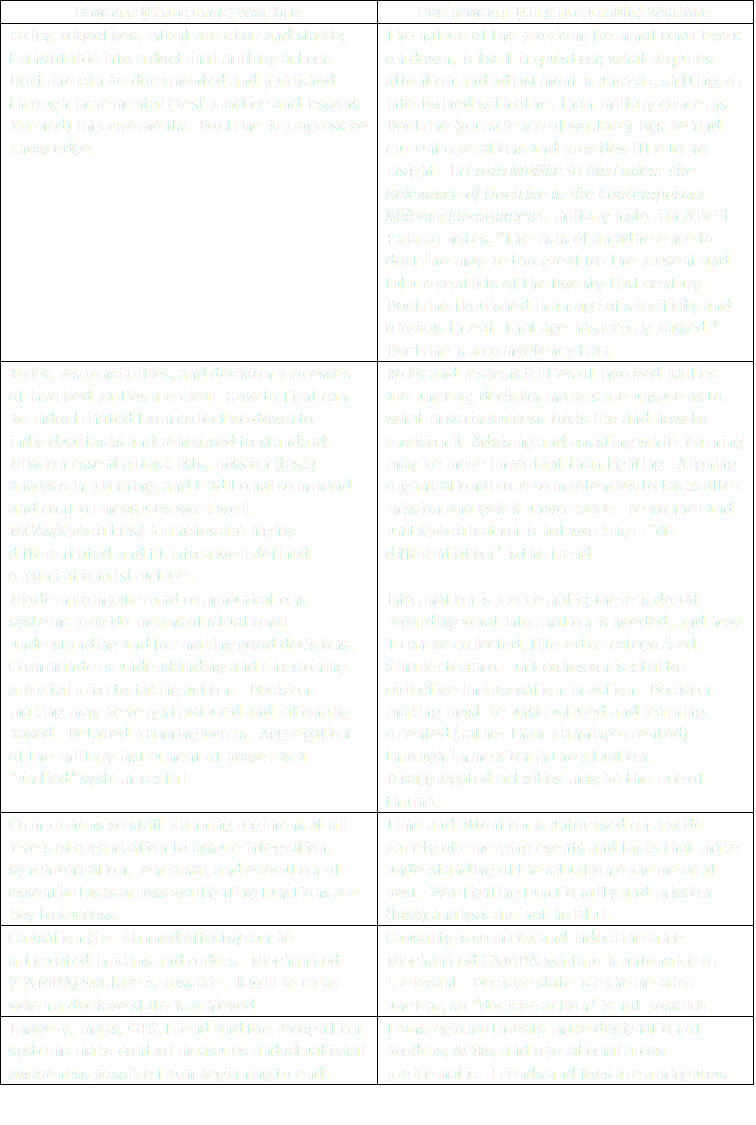
My challenge to the reader is how to re-conceptualize logistics to support unstructured activities (the right side of the chart) when highly structured logistics systems are designed to support CAMDA (the left side of the chart)?
Editor’s additional question: given the discussion on this site and elsewhere concerning new concepts including ‘Multi-Domain Battle’, are we falling into a conceptual ‘CAMDA trap’?
Chris Paparone, COL, US Army retired, served 29 years as a logistician and since 2002 has been involved in the US Army military education system.
Follow us at Twitter: @logisticsinwar and Facebook : @logisticsinwar. Share this article to grow the network and continue the discussion. If you want to contribute to Logistics In War, please check out the link above.


 The Paper War: Logistics... and everything but the fighting.
Leave a comment