
By David Beaumont
The stabilising forces that once made global logistics flows all but a secondary concern for strategists, government policymakers, and defence planners are now under severe strain. With every reminder given to Western militaries that global supply chains are fracturing, munitions are in short supply, fuel sources are being disrupted, and sovereign defence industry lacks the scale demanded by the geostrategic environment, a decline in the strategic freedom of manoeuvre available is being seen. We are entering an epoch of enlivened geoeconomics, in which civilian and military supply chains have become so intertwined as to be inseparable, and in which the logistics dimensions of force posture are being recognised as just as important as the positioning of forces themselves.
Somewhat superficially, we bundle these issues within a concern for supply-chains security, an issue quite pronounced in national policy statements in a general sense. Yet this is not the deeper strategic logistics challenge that imperils the assumptions of military planners. Instead, the epochal issue – the definitive logistics concern of an emerging era – is the collapse of assured access to the global industrial base. Western nations and alliances now face the reality that no longer do they possess the industrial depth, surge capacity, or protected and secure logistics networks needed to sustain military forces engages in a high intensity, multi‑theatre conflict. Self-reliance is now extolled as the liminal logistics idea, and militaries flock around the idea of ‘contested logistics’; a conceptual solution to the problem of connecting militaries to a world in which the ways of supply are increasingly under direct threat.
In looking to understand this environment we might find that the most consequential transformation in the character of war is not that drones are proliferating the battlefield, nor that industrial‑scale attrition alone defines state-on-state wars. Massed fires might be important in a battlefield yet may not prove the decisive factor what combat forces have to protect from if they are to be sustained. Equally, AI-fuelled precision targeting and guided weapons may not be speaking the true grammar of the 2026 battlefield, despite the impressive shock that a strike might cause to an opponent. The battlefield continues to disperse as the killing firepower available to military forces grows, potentially refilling with atrittable robotics – but even that may not be the most important change we are seeing.
Perhaps we will find that the character of this age of war relates to the growing exposure defence forces now have to the contested conditions of the global commons, and more specifically what Deborah Cowen once termed ‘logistics space’. These are the areas of geopolitically relevant, commercially vital, and militarily indispensable geography through which goods, energy, data, and materiel circulate, and upon which all states depend for the projection and sustainment of force. They are the regions of the world where the logistics flows that provide preparing military forces, and the societies they protect, access to needed industry capability’; places of such economic importance that they can be no other than an area of vital strategic interest. If logistics is a process, connecting national economic and productive capacity to the battlefield, logistics spaces are regions of the world have the potential to be, if not already are, battlegrounds.
For many years, perhaps since the Cold War ended in the 1990s, Western nations and their defence establishments have largely assumed logistics spaces were neutral rather than areas of virtually continual contestation. Both undoubtedly knew these places, vital to supply-chains, needed to be protected else their nations would have needed to make greater investments in homegrown industrial capacity to keep military capability costs down. These logistics nexus points were produced by the demands of global military and civilian supply chains, secured through political bargains, commercial risk calculations, and economic arrangements fixed in a geopolitically stable environment. The contestation now seen around and for them has occurred because nations recognise their implications for coercion, but also to the preparedness of military forces that could post a risk.
It doesn’t take too much imagination to conclude that these militarily relevant logistics spaces are now vulnerable, because most of us viscerally understand how supply-chain security affects our everyday economic wellbeing. Each global supply shock created by circumstances both natural and man-made drives prices up for commodities necessary for daily life. The cost of moving the lifeblood of national wealth through discrete regions of the world continues to rise, worsened by conflict and other tensions that interrupt logistics flows.
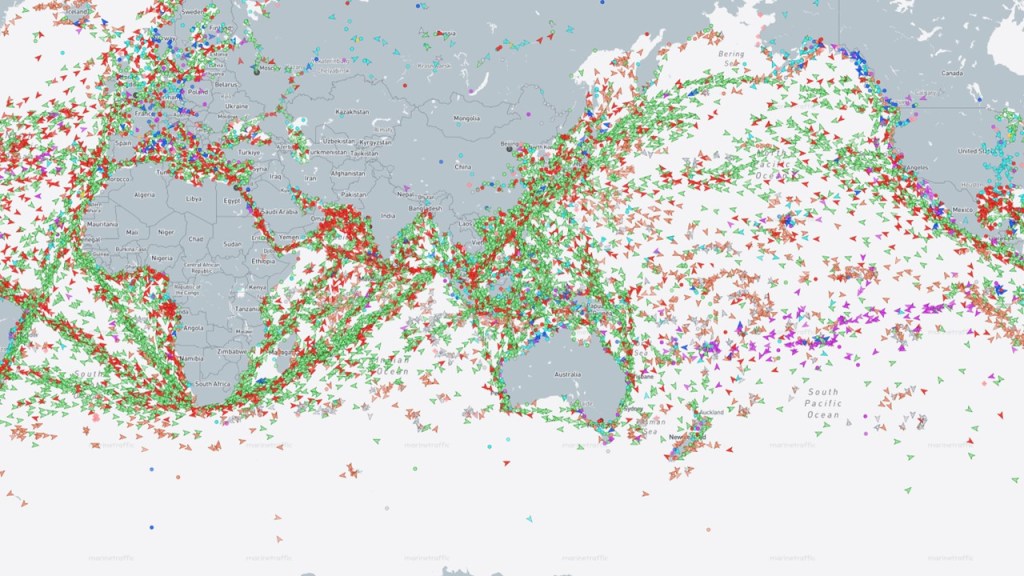
Global shipping as at 25 Mar 2026, from http://www.marinetraffic.com
However, we are only at the beginning of our understanding of what the impacts of this epoch will be for defence forces. The wars since 2020 have alerted forces to risks in how they build, prepare and employ capability. It is virtually certain that it will be difficult to use global supply-chains to the extent possible in the past – the limited global supply of munitions provides an example of a problem area where reducing global access has created a dillema – but the situation also poses a challenge to the development of sound strategic policy. Logistics space has always been an important strategic matter; now it is not just a background condition but a new terrain that must be comprehensively considered and prepared for.
For example, the assured access to industry capability and capacity has shaped the strategic and operational choices faced by leaders in defence of Ukraine. A recent article by Mick Ryan describes an ‘Interdiction War’ in Ukraine, a marker of Ukraine’s ‘systematic and increasingly effective interdiction campaign’ against specific logistics infrastructure and forces near Crimea. Harking back to the outset of the conflict, the large-scale destruction of military convoys from Russia to Ukraine was a poignant reminder of the channelling effect of logistics infrastructure, and the way that these spaces could be utilised as the killing ground of an advancing military force.
But the war between Ukraine and Russia has long been a war in which industrial production, energy grids and supplies, ports and rail networks, as well as repair hubs have been victims of strategic strikes. As Ryan remarks, the disabling of rail networks is ‘squeezing’ Russian supply to Crimea, and deep strikes on oil infrastructure is creating economic attrition.
There is more, of course, to the logistics of the war in Ukraine than the targeting of vulnerable supply-lines, and the halting of advancing forces. Innovation and adaption in Ukrainian industrial capacity, supply and distribution created the opportunity for strategic and operational advantage. They have created new logistics spaces in which to operate, new combinations of capability that create options for a nation at war.
When Russia looked to collapse Ukraine’s logistics space by attacking power grids, rail hubs, repair facilities, and industrial nodes, the war became a struggle over whether Ukraine could build alternative logistics spaces and keep them, open long enough to sustain national resistance. Artillery duels became production duels, UAV innovation became a race in which industrial adaption – such as the dispersal of production – determined results, and novel approaches to sourcing equipment and logistics flows shaped the unfolding of the conflict.
Now, in Ukraine, we can see the dispersion of industry capability whereby micro-factories form the basis of a resilient industry system developed because of a wartime economic environment. Ukraine turned to such improvisation not because it preferred – it is possible that had Ukraine access to the precision weapons it needed, adaption may never have occurred – but because the advantage that proximal and resilient industry systems were the only way the defence of Ukraine could be prosecuted.
In the wake of US strikes on Iran, but also the conflict in Gaza, we can see that logistics space is defined by its commercial, but also profoundly political, character. Contested logistics is not just a battlefield concern in the Middle-east, but is increasingly linked to the entanglement of military, political and commercial infrastructures and interests in the region.
In the case of the former, attacks on merchant shipping and political threats to close chokepoints forced carriers to reroute, insurers to raise premiums, and induced an oil shock that has had cascading effects across the globe. Ballooning shipping and freight costs have created a new commercial reality for populations around the world but have also made it difficult for militaries to prepare for the changing strategic environment. The cost of capability is rising with inflation, and with the declining availability of products so necessary for a military to function.
In most cases, disruptions were not the consequence of collateral damage, but the deliberate decision by countries to control the logistics flows. This was the deliberate contestation of logistics space. The global economy— that nominally neutral backdrop —revealed itself as a logistics space vulnerable to coercion, and the fragility of that space reshaped national security planning in real time.
Australia’s 2026 National Defence Strategy (NDS26) speaks to this new reality, articulating that Australia faces risks to its economic well-being as well as its military capability. Through attention to the defence industrial base, supply chain resilience and national logistics infrastructure, the strategy looks to improve Australian self-reliance. This is not a rhetorical flourish, but an admission that the logistics spaces that Australia depends upon can no longer be assumed to remain open, that a nation which cannot sustain itself cannot deter, and that Australia and its defence force must adapt accordingly.
NDS26’s emphasis on self‑reliance is not a nostalgic return to autarky. Instead, it is a recognition that the defence of Australia can only be achieved through assured access to globalised industry capability that traverses through contested logistics terrain. Furthermore, it is an admission that Australia’s strategic credibility requires the ability to operate within such terrain even when it is under attack. The strategy’s call for sovereign industrial capacity, diversified supply chains, and resilient national infrastructure is not an optional enhancement but is becoming a strategic necessity.
Logistically speaking, the world is a much more dangerous place than it has been for decades. Industrial spaces have been attacked, disrupted, or overwhelmed via attacks across all domains, and especially through cyber. In the maritime domain, logistics flows have been the tool for coercion, have been rerouted, or are no longer practical lines of communication due to the price of their use. In politically charged spaces, the closure, constraining, or weaponisation of logistics has become a tool to constrain the strategic manoeuvre of military forces. Digital spaces have been targeted by cyberattacks that disrupt command, control, and supply. These factors define the new structure of war in their totality; this is the environment that militaries must be prepared for. Cowen’s insight—that logistics space is a political and contested geography produced through the circulation of goods and secured through violence—has become the organising principle of contemporary conflict.
We are now in a time where the decision to use military force will be hostage to the need for militaries to be able to access assured industrial capability. While logistics has often been treated as the soft underbelly of a fighting force, the magnitude of the sustainment risk now facing military forces is growing. Not only do militaries depend upon international sources of supply, but they are also likely to be expected to secure such sources. As military and civilian supply chains are one and the same, there can be little doubt that the logistics spaces of the world will be at the forefront of government officials minds. At the very least, the assumption that Western militaries will have unfettered access to open logistics spaces, that global supply chains will be organised, that commercial actors will comply, and that adversaries will refrain from attacking the connective tissue of national power, will likely prove false. As I wrote in 2017, any strategy that ignores logistics space as an influence of assured access to industry capability will ultimately be strangled by it.


Leave a Reply